
Anti-Dive / Anti-Lift / Anti-Squat – Suspension KPI
Any vehicle which is accelerating, or braking will experience a longitudinal force at its centre of gravity. This force will case the vehicle to pitch and is mainly reacted by the suspension springs and dampers. The layout of the links in a suspension system can also be used to modify the amount of pitch a vehicle experiences for a given braking or traction force. This mechanism is referred to as the suspension anti-properties. Suspension anti-properties is an umbrella term for the following key performance indicators:
- Front suspension Anti-Dive under braking
- Front suspension Anti-Lift under traction
- Rear suspension Anti-Lift under braking
- Rear suspension Anti-Squat under traction
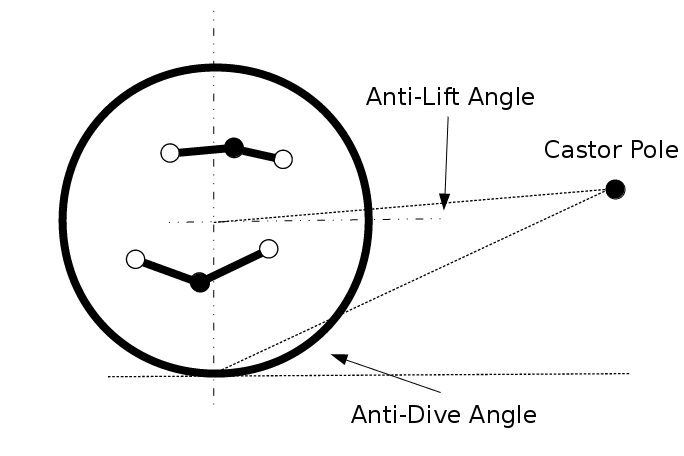
The amount of Anti-Dive or Anti-Lift in a suspension system is controlled by the position of the castor pole relative to wheel centre (see the post on bump castor for an explanation of the castor pole). The anti-dive and anti-lift angles are shown for a front suspension below. In RACE the anti-properties are reported in Degrees and also as Newtons of vertical force per Newton of longitudinal force, N/N.
How much anti-properties a vehicle requires very much depends on the mass properties, wheel base and tune of the vehicle.
This KPI page is only a brief overview. To learn more about this and other KPIs, including KPI values used in industry, real-world examples and best-practice guidance, please refer to our courses below.
—
ENHANCE YOUR CHASSIS AND SUSPENSION SYSTEMS EXPERTISE WITH CUTTING-EDGE SOFTWARE SOLUTIONS AND SUSPENSION COURSES
AUTOMOTIVE/MOTORSPORT SUSPENSION AND CHASSIS SYSTEMS – DESIGN AND ENGINEERING FUNDAMENTALS COURSE
SUSPENSION PERFORMANCE TUNING USING MULTIBODY SIMULATION SOFTWARE COURSE
START USING RACE SOFTWARE TODAY WITH A FREE TRIAL ON ALL PLANS